
During election coverage, a common refrain among older folks is their concern that young people are sitting at home without jobs, sometimes not even looking for one, happily scrolling through reels. Talk to young people and they often speak of a lack of coherent job opportunities or the skills that match the demands of the market.These often-heard anecdotes are given a more coherent shape in Reimagining Skilling for Viksit Bharat@2047, a new report from the government’s policy think tank NITI Aayog. The report attempts a candid diagnosis of where India is, and how it can become a developed nation by 2047, the centenary of Independence.Beyond merely ticking boxes on broad numbers of people trained, the report examines the barriers that determine whether skilling actually leads to work. Money, information, mobility, family circumstances, access to institutions and exposure to the workplace all matter. In that sense, it also tells a larger story about how the circumstances into which a young person is born can influence where he or she gets slotted in life.The report focuses, among others, on a group of young Indians who do not fit neatly into the conventional categories. They are neither in school or college, nor employed or undergoing training. Policy researchers have an acronym for them: NEET, or Not in Education, Employment or Training.
What exactly is NEET?
NITI Aayog’s new report puts 8.7 crore people in a NEET youth bucket in its map of India’s population. After the figure was interpreted in some reports as a measure of unemployment, the government issued a clarification. It said the 8.7 crore estimate refers to young people who were not seeking employment, while the unemployed form a separate category drawn from a different population base.In the NITI report, NEET youth are defined as those aged 15 to 29 who are not engaged in education, employment or training. The footnote describes approximately nine crore as “NEET excluding seeking jobs”, based on the NSS 78th Round of 2021, and says roughly 88% were engaged in domestic duties.In its clarification, the government has provided further clarity. It said the category includes young people engaged in voluntary work or household enterprises, attending to domestic duties, unable to work because of a health condition, spending leisure time, and others.
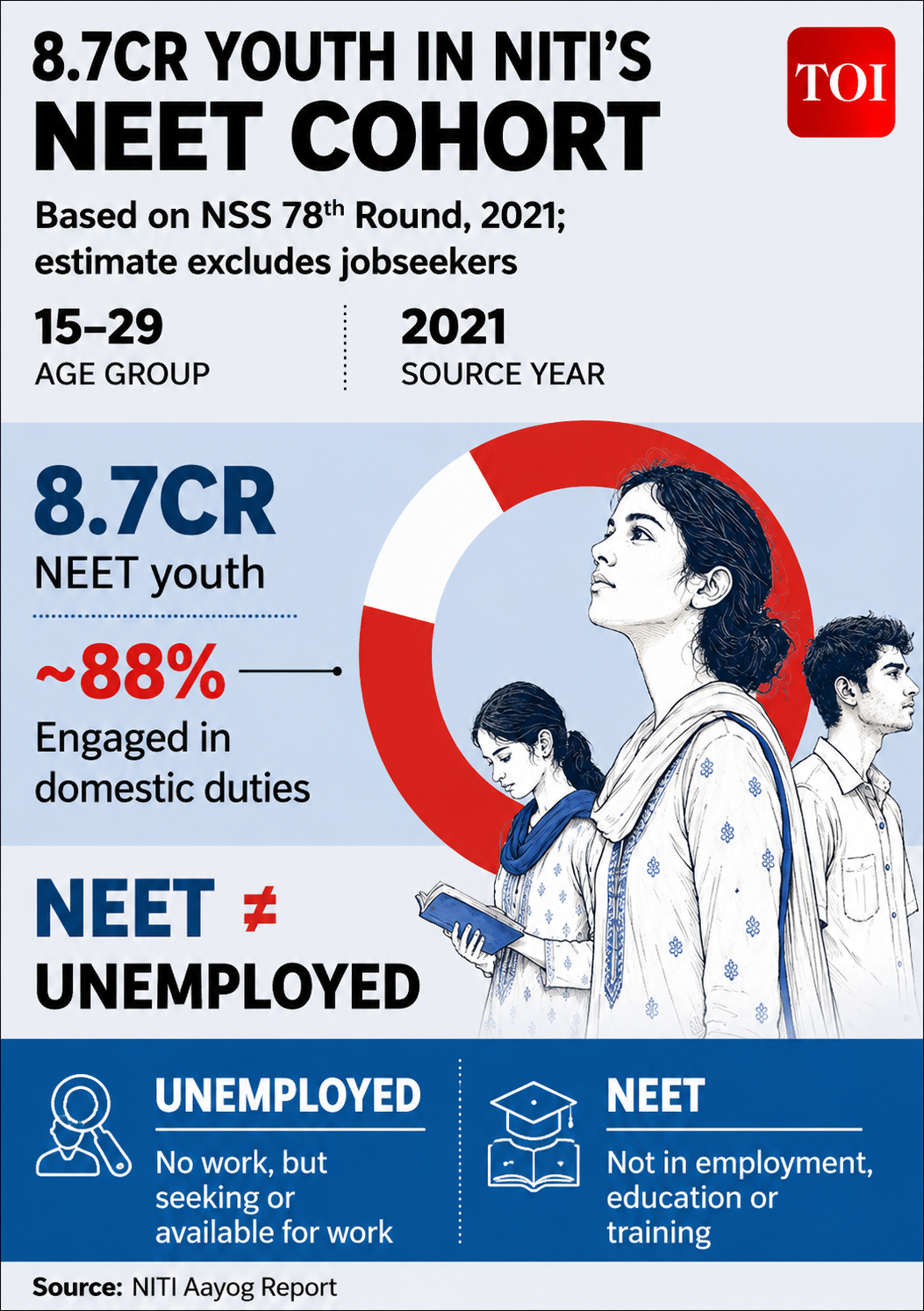
Unpacking what is NEET
The Covid factor
NITI’s population exhibit starts with an estimated 145 crore Indians. It shows 65.4 crore, or 45.1%, in the labour force, and 79.6 crore, or 54.9%, outside it.Among those in the labour force, the exhibit shows 29.23 crore in agriculture, 34.24 crore in non-agricultural work and around 2 crore unemployed. The unemployed are part of the labour force because they are seeking employment.The population outside the labour force is split into roughly 29.1 crore students, 11.3 crore children below five, 15.7 crore people aged 59-plus, 14.7 crore in other categories and 8.7 crore NEET youth.There is another important qualification. The 8.7 crore estimate is based on the NSS 78th Round of 2021, which included a Multiple Indicator Survey (MIS) to assess different socio-economic parameters. The government subsequently pointed out that the data used to calculate this figure was collected in FY2020-21, during the Covid-19 pandemic, when education and employment were severely disrupted. It said the figure could therefore represent a deviation from the normal trajectory.The government points to the latest PLFS to say that the youth NEET percentage is now “significantly lower”. The PLFS Annual Report 2025 estimates that 25.0% of Indians aged 15 to 29 were not in employment, education or training under the usual-status measure. For those aged 15 to 24, the corresponding figure was 21.0%.The NITI report itself warns that its population exhibit is a “static snapshot” constructed using different datasets, including PLFS, UDISE, AISHE and NSS, with reference years ranging from 2021 to 2024.NITI followed a mixed-method approach across five groups of school students, tertiary learners, formal and informal non-agricultural workers, NEET youth, and women as a cross-cutting segment. Agriculture was excluded because NITI says the sector requires a separate analytical framework.Its quantitative evidence draws on the MSDE State of Skills Survey 2024, covering roughly 8,000 learners, and BCG’s Higher Education Survey 2023, covering roughly 4,000, supplemented by more than 60 in-depth interviews, focus groups and industry conversations.
NEET youth have an information problem
Among surveyed NEET youth who had not undertaken or completed a skilling programme, 43% cited lack of awareness of the right programmes as one of their top three reasons for not pursuing skilling. The corresponding proportion was 55% among informal workers, 52% among formal workers, 47% among women and 36% among higher-education students.The report says young people often make choices based on examination scores, family preferences, cost or social prestige rather than a clear understanding of what exactly is needed to get a job. Vocational education and ITIs are often viewed as second-tier options, while online courses are often perceived as unreliable.
The money problem
NITI describes affordability as a “binding constraint”.NEET youth, it says, face the particular disadvantage of having no income while also carrying the sunk cost of their previous education. In simple terms, that is the cost already incurred on an education that may not have translated into work.For low-income workers, even a free course can be expensive if attending it means losing wages. In other words, the opportunity cost of training can remain high even when the course itself is free.The report shows how price-sensitive the wider skilling market is. More than 80% of informal workers who undertake skilling do so either free or for less than ₹10,000. Among women who undergo skilling, 72% either take a free course or pay less than ₹5,000, compared with 52% of men.NITI’s prescription for NEET youth is based on understanding this ground reality. It advocates affordable or subsidised training with financial support, along with the ability to combine learning with earning instead of having to stop work for weeks or months.
Courses have ‘weak outcome orientation’
NITI says 82% of NEET respondents report a foundational gap in existing skilling programmes involving job-interview preparation and placement tie-ups.This is where the report turns its gaze on the skilling system itself. NITI describes “weak outcome orientation” as a “core limitation” of many existing skilling programmes. It says programmes often prioritise enrolment and completion over placement, progression or income outcomes.That observation becomes significant when set against the sheer scale of India’s skilling push. The report says more than 7.67 crore individuals have been trained since 2014-15, while around ₹34,000 crore was allocated towards skilling-related expenditure across central ministries in FY2025-26.The government, meanwhile, says it has begun implementing some of the report’s recommendations. It points to the ₹600 crore Integrated Scheme in Skilling Architecture (ISSA) announced in the Union Budget 2026-27 as part of an effort to strengthen convergence across education, skilling, employment and lifelong learning.
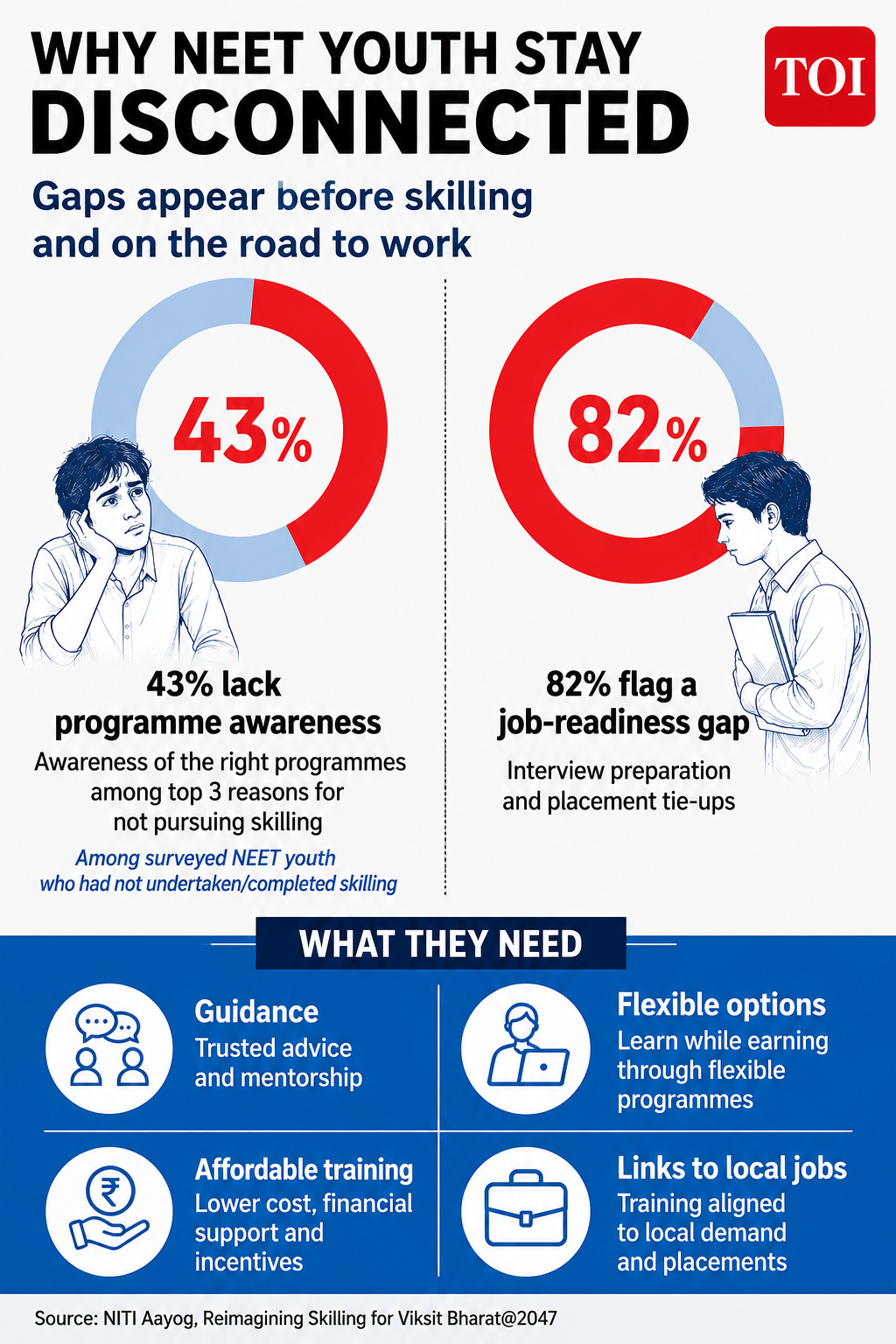
Reasons behind feeling disconnected
The problem NITI identifies is visible even among people still in education.It says 80% of higher-education students cite lack of practical experience and industry exposure as a major pain point, while 47% of formal workers identify lack of prior work experience and internships as the top challenge when finding new jobs.Among undergraduate students dissatisfied with their education outcome, 34% cited lacking skills and 18% inadequate interview preparation. Among higher-education students aspiring to entrepreneurship, the report says 61% are unaware of pathways to pursue it.The larger point is that a degree by itself does not guarantee workplace readiness. Somewhere between the classroom, the training centre and the employer, the route from learning to earning needs to be more robust.
An illustrative pathway
NITI uses a character called “Meera” to illustrate how its proposed system might work.In the illustration, she gains some vocational exposure in school but drops out following household constraints and early marriage at 18, becoming NEET. She then discovers a nearby short-term beauty course, receives a skill voucher, moves into a nearby part-time salon job and ultimately towards self-employment.In NITI’s illustration, that part-time job pays ₹15,000 a month, before she starts taking clients independently.The point is that for someone who has dropped out of both learning and earning, the route back is unlikely to be a single jump from NEET to a permanent salaried job. It will generally go through a short course, flexible work and then a steadier livelihood.
Share your thoughts in the comments
Be respectful · TOI community guidelines
The official unemployment count, then, is only one measure. What also matters is whether young Indians stay connected to at least one of three systems of education, training or earning.NITI’s findings point to something larger than a skills gap. They also point to a privilege gap.Bridging that privilege gap may be the most sober takeaway from NITI’s roadmap to 2047. India’s demographic dividend will not be realised merely by counting how many people receive training certificates. It will depend on whether young Indians, irrespective of the circumstances they start with, have a credible route from learning to earning.As economist and philosopher Amartya Sen wrote in Development as Freedom, “Development can be seen … as a process of expanding the real freedoms that people enjoy.”