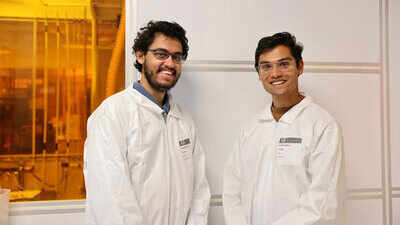
Every new generation of artificial intelligence is demanding more powerful chips. But there is a problem hidden beneath the algorithms, data centres and billion-dollar AI models: the chips themselves are getting dangerously hot.According to San Francisco-based startup Discovered Materials, AI chips today can face heat fluxes of around 140 watts per square centimetre. Managing that heat is becoming a major engineering challenge—and finding entirely new materials capable of improving chip performance has traditionally taken years, sometimes more than a decade.Two IIT Madras alumni now believe artificial intelligence itself could help speed up that process.Advaith Sridhar and Akash Ramdas, who first met at IIT Madras more than a decade ago, are the co-founders of Discovered Materials, a deep-tech startup building AI agents to discover new materials for semiconductor chips. The company announced a $9 million seed round in August 2026, led by Lightspeed India Partners, with participation from Y Combinator and Peak XV Partners, as well as angel investors including Y Combinator co-founder Paul Graham.
The problem is not just designing a better chip
Semiconductor technology is often discussed in terms of transistors, chip designs and manufacturing plants. But every chip is also constrained by the materials from which it is built.Better materials could potentially help chips run cooler, consume less energy and enable new forms of packaging. The problem is that identifying a promising material, testing it, synthesising it and eventually adapting it for manufacturing can be an extremely slow process.Discovered Materials is trying to change that workflow.Its approach uses what the founders describe as a swarm of AI agents capable of working across different stages of materials discovery. The company’s stated goal is to reduce a process that can take more than 10 years to a matter of months.
Two IIT Madras classmates, two different specialisations
The founders bring together two very different areas of expertise.Ramdas completed his PhD in Materials Science at Stanford University and spent years researching new semiconductor materials. According to Y Combinator, his work on nanoscale interconnects has been incorporated into the technology roadmaps of Intel and TSMC.Sridhar studied AI at Carnegie Mellon University and previously worked on autonomous agents at Persona AI and Luma Labs.They had known each other since their IIT Madras days. Years later, their respective backgrounds in materials science and AI converged around the same question: could AI help scientists discover entirely new materials faster?
Hundreds of AI-discovered materials—and a difficult reality
Alongside its funding announcement, the company released Material Discovery Bench, an open benchmark designed to test how well frontier AI models can discover materials for real-world semiconductor problems.The project has already generated more than 500 previously unknown computational material candidates, according to the company’s research.But there is an important catch.Finding a theoretically promising material is not the same as making it in a laboratory.Of the more than 500 materials identified in the benchmark, the company’s initial results found that only one had a plausible synthesis pathway that met its criteria. That gap between computational discovery and actual manufacturing remains one of the biggest challenges for AI-driven materials science.
‘In the last 3 months…’
Ramdas said the company’s work has already produced encouraging results.“In the last 3 months, we have made new thermal materials that match the performance of products that the world’s largest chemical companies took years to develop,” he said, according to Business Standard.The claim represents the founders’ assessment of their early results, but it illustrates the scale of their ambition.Rather than simply using AI to design software, Discovered Materials wants AI agents to participate in one of science’s slowest processes: the search for physical materials that do not yet exist in commercial use.For India, the significance could lie further upstream than the current conversation around semiconductor fabs and chip manufacturing.Building chips requires factories. But future generations of chips may also require materials that have not yet been discovered.Two IIT Madras alumni are now betting that AI could help find them.